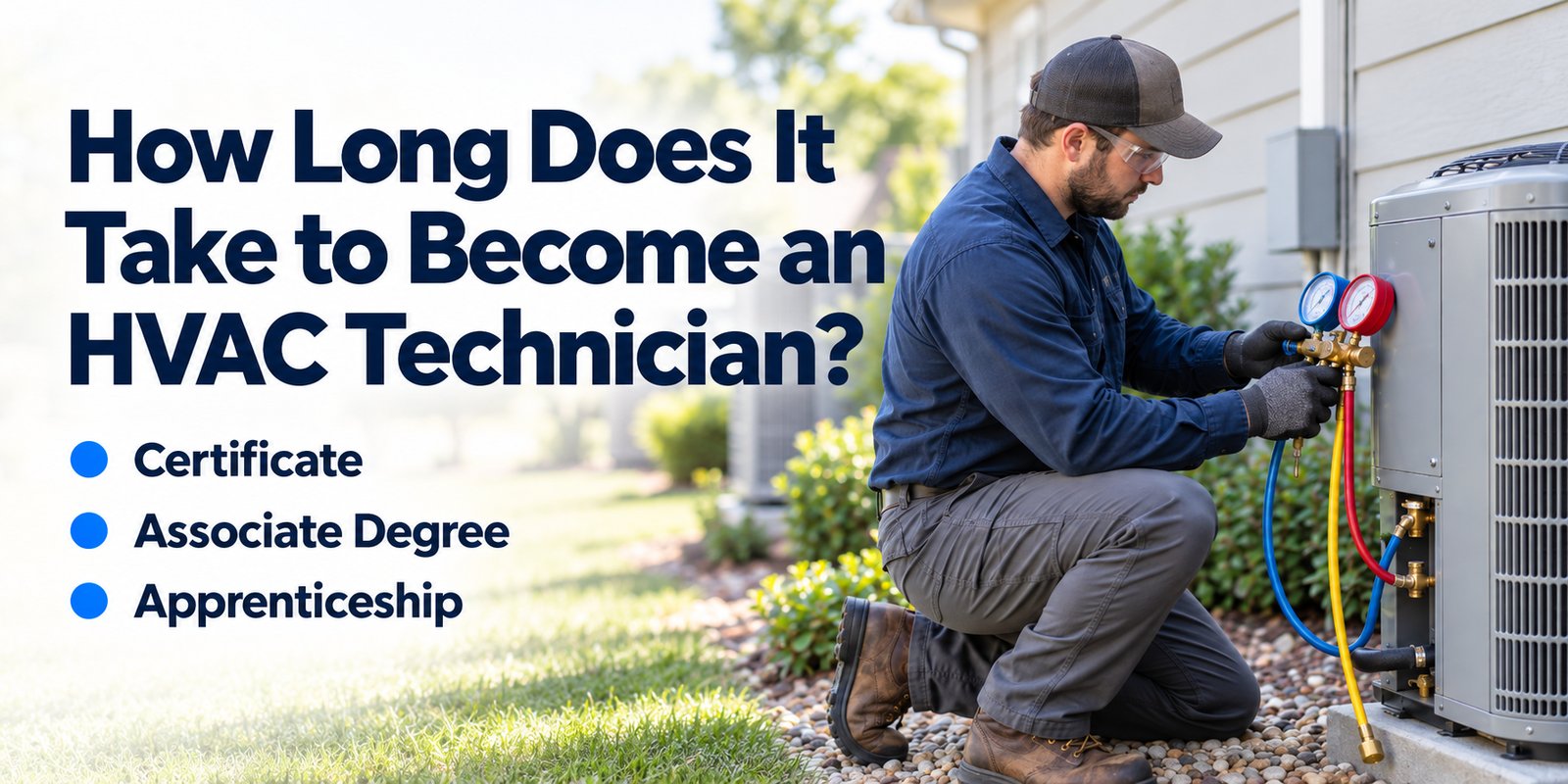
How Long Does It Take to Become an HVAC Technician? (2026 Update)
See if you qualify for HVAC programs
Answer a few questions in 2 minutes. Free, no commitment.
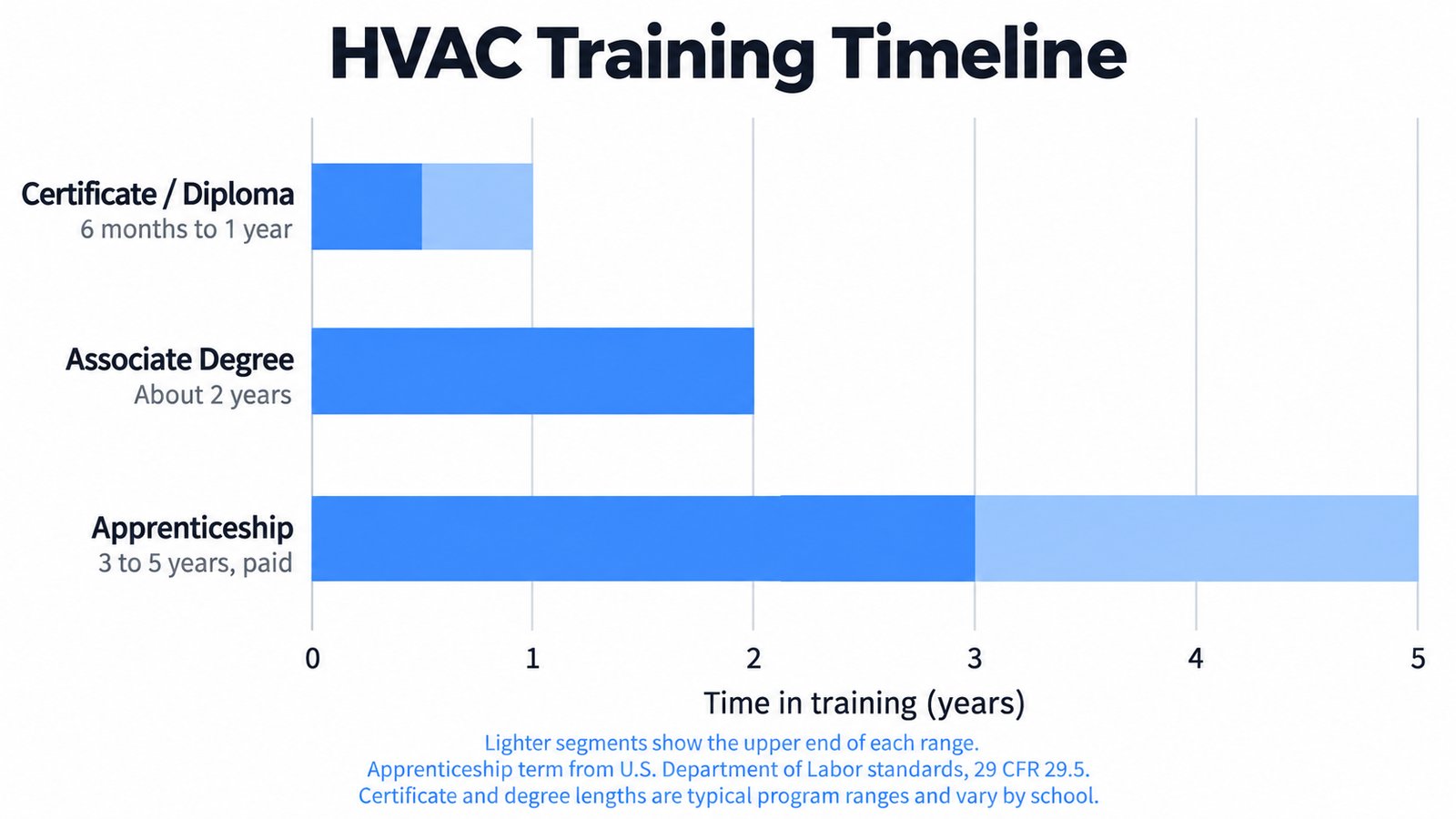
HVAC technicians work with their hands on heating, ventilation, and air conditioning systems, and the trade draws people who like solving mechanical problems in the field. The common question is how long it takes to become a certified HVAC technician. The answer runs from 6 months to 5 years, depending on which of three routes you take: a certificate or diploma, an associate degree, or a paid apprenticeship. The gap between them is not difficulty. It is whether you pay tuition or draw a wage while you train.
Key Points
- Certificate and diploma programs: 6 months to 1 year
- Associate degree programs: about 2 years
- Apprenticeships: 3 to 5 years, commonly structured as 4 years and roughly 8,000 hours of on-the-job training
- Apprenticeships are typically paid, with wages rising on a schedule the program registers
- EPA 608 certification is required for handling regulated refrigerants, has no set course length, and does not expire
How to Get a Job After Classes?
After completing your HVAC training and obtaining the necessary certifications, you can begin looking for work as an HVAC technician. Here are some steps you can take to increase your chances of finding a job:
- Build a strong resume: Highlight your relevant skills, training, and certifications on your resume. Include any hands-on experience you gained during your training program or apprenticeship.
- Network: Connect with professionals in the HVAC industry through industry events, trade shows, or online platforms. Networking can help you learn about job openings and meet people already doing the work.
- Apply for jobs: Look for job openings at HVAC companies, contractors, or maintenance departments. You can also consider reaching out to local HVAC businesses directly to inquire about potential employment opportunities.
- Prepare for interviews: Practice common interview questions and be prepared to demonstrate your knowledge and skills during the interview process. Show enthusiasm for the HVAC industry and highlight your willingness to learn and grow in the field.
Frequently Asked Questions
What is the fastest way to become an HVAC technician?
A certificate or diploma program, at 6 months to 1 year. It is the shortest of the three routes to a credential. The EPA 608 exam is usually taken during the program rather than after it, so it does not add a separate stage.
Is an HVAC apprenticeship better than going to trade school?
Neither is better in the abstract. An apprenticeship pays you throughout and takes 3 to 5 years. A certificate or associate program charges tuition and finishes in 6 months to 2 years. The decision turns on whether you can wait longer for the credential in exchange for earning during training, and on whether a registered apprenticeship is open near you at all.
Do you get paid during an HVAC apprenticeship?
Yes. Federal rules require a registered apprenticeship to pay a progressively increasing wage, with an entry rate no lower than the applicable minimum wage. Each program registers its own schedule of increases. On federally funded construction work, apprentice pay is set as a percentage of the journeyman rate for the classification, rising at each level of progression.
How long does it take to get EPA 608 certified?
There is no required course length, because EPA does not set one. Certification depends on passing an exam through an EPA-approved certifying organization, and the test is specific to the equipment type. Once passed, the credential does not expire.
How much does an HVAC technician make right out of training?
BLS does not publish wages by experience level, so the honest answer is a range rather than a starting figure. In May 2025 the lowest-paid 10 percent of heating, air conditioning, and refrigeration mechanics and installers earned $40,050 or less, the median was $61,010, and the top 10 percent earned more than $95,210.
Do you need an associate degree to become an HVAC technician?
No. BLS lists the typical entry-level education for the occupation as a postsecondary nondegree award, which a certificate or diploma program satisfies. An associate degree is one route among three, not a requirement, and an apprenticeship requires no degree at all.
Final Thoughts
The honest answer runs from 6 months to 5 years, and that spread is not about difficulty. It is about which trade-off you accept. A certificate is fastest to the credential. An associate degree adds general coursework and roughly another year. An apprenticeship takes the longest on paper and is the only one of the three that pays you while it runs. All three end at the same EPA requirement and the same field work. Comparing HVAC programs on Dreambound by length and format shows which of the three fits the time you actually have.